Showing posts with label The City Darkens. Show all posts

Wednesday, January 25, 2017

Writing again, despite fatigue and lack of time!

I've been going nuts for months now with inspiration for new stories and ideas for the WiPs (mainly the third Raud Grima book, tentatively titled Masks in the Glow). And up until the winter break I just couldn't find the time or the energy, except for occasionally rereading already written passages of Masks and tinkering with them. Then over winter break we got me a new laptop (the kids smashed the old one) and I carved out two chunks of time for writing. Since then, I've managed to write several more times, mainly in the evenings while dinner's cooking and for a little while after. Historically evenings have never been my writing time. Too tired out by the day for any kind of good concentration. But desperate times call for desperate measures.

So I'm very slowly making progress on Masks, which may end up not being called Masks because it's looking like it's going to be upwards of 200K words and therefore will have to be split into two. If that's how it works out (I'm not sure because I devised a way to shortcut the story and I haven't decided whether I want to go that route or not) then probably the fourth and last book will get the Masks title and book three will have to go by something else.

This series is definitely shaking out to be weird in a lot of ways. First just going with the dystopian decopunk angle, which you don't run into very much. And certainly not often with the Fritz Lang inspiration so central. So there's that, to begin with. I mean from the start I've run into people who just scratch their heads at the whole concept of robots in an art deco city.

I chose from the beginning to challenge myself to write scenes that make me uncomfortable. I address one of my greatest fears in the book--the loss of a child--which probably doesn't weird anyone out. But I also pushed myself to write sex scenes, which is not something I'm generally comfortable with. And I wanted them to be real, with heat and in some cases disturbing elements. So yeah, that has certainly colored both The City Darkens and After the Fall and based on the few reviews I've gotten, people either appreciate what I was trying to do or are really put off by all the sex.

Then, in After the Fall, I switch narrators. I knew that was unconventional and would probably put people off. It's not like it's never been done before or anything, but it's a risky thing to do. I did it because I couldn't figure out what to do with Myadar. I wanted to keep talking about this city that's going through a revolution and there was no good reason for Myadar to get in the middle of that. At least, not right away. So I thought about what I wanted to talk about--I wanted to have the books progress a bit like the decades that comprise dieselpunk--City was the 1920s, Fall was the 1930s (sort of--certainly with a look towards what was happening in China at the time), and Masks would be the 40s. In no way am I trying to tell a history of America or even Earth, though. I just want parts of the setting, the events, the things people do, to resonate, like, "Oh, I see what she's doing there!" Anyway, so Fall was going to be about survival, first and foremost. How does an ordinary person survive a cataclysm in her city? What would that survival look like? Who threatens it? I thought of my graduate professor of African history talking about the role of young men, packs of violent young men, in unstable environments. And since I was also reading about grimdark at the time, and the ways people were (perhaps) mishandling violence in fiction, particularly sexual violence, I wanted to try my hand at that, and see if I could pull it off in a way I could live with. And I allowed Ginna to embody my own struggle with the necessity of violence. To top it off, I believe that the second installment in a trilogy (which is what I intended this series to be) should end badly. So the result was a novel that's really not very satisfying to some readers.

And now, Masks will be different yet again. For one thing, it has four POVs. For another, so far, no sex. And in it I'm trying to resolve both my conflicted feelings about using violence in fiction and Ginna's conflicted feelings about using violence to win the war. I am also really focused on characters that are not inherently good (Ginna is, though). Plus my original idea was to go very dark and flirt with atompunk, and though I may still have an element of that (inspired, perhaps, by Akira), the aesthetics of light decopunk like Sky Captain and the World of Tomorrow are still really appealing to me. So I've revisited what one of the big threats will be and I've reimagined it, and it's probably going to strike people as even weirder than robots in a deco city. I guess we'll see.

Masks is already 100K words and even if I do the shortcut I mentioned, I'm probably looking at at least another 40K. So I'm leaning towards writing the long version, seeing how many words it is, and deciding based on that whether to split it.

If you were reading a series, would you rather that the last book be very long, or that what you thought would be the last book ends in a cliff hanger and you have to read yet another book to finally get the resolution?

Does it bother you when books in a series have different POVs?

Would you be frustrated if the first books had several sex scenes and the last had few to none?

What do you think of violence in fiction?

Monday, November 14, 2016

Exhaustion, Fear, Sorrow and Rage

All getting in the way of my writing.

What can I say, the election was certainly historic.

A personal friend was the victim of a Trump-fueled hate crime.

I am swinging between each of the titular emotions I listed at any given time. It's definitely getting in the way of my ability to concentrate. But today I am going to write a paragraph into the first chapter of Masks in the Glow that is directly inspired by the election. And I will continue to work on this WiP with this election in mind. After all, The City Darkens didn't come out of nowhere. I just didn't think we'd have our own dystopia unfolding within a couple of years of its publication.

I don't know what this means for the future of my writing--I had plans for the next novel(s), and they were not dystopic. And I may still go forward with the main idea--I was going to try to create a beautiful world, one that I would enjoy escaping to. Which was actually the plan with The City Darkens but then it didn't work out that way at all! But maybe now my readers need it more than ever, and I certainly will be seeking out such worlds to immerse myself in, as I choose the novels I will be reading.
"Escaping the Dome," by yumikrum on wikicommons

But I also feel like dystopia may well be the way to go. I only have so many ways to try to warn the world, to try to stop the tide--and it may be futile. Hell, it might be like painting a target on my back. I know this comes off as melodramatic, but the man asked multiple times why we don't just use our nukes. We are in a melodramatic age.

I plan to join some progressive groups locally and I have another plan I'm following through on but it's going to be a few months before I get a sense of whether it's likely to come to fruition.

No matter what, I have to get back to writing. I am not really well unless I'm writing--at least not in times like these.

Saturday, April 9, 2016

Machiavelli, Mary Sue, Supernatural, and Gale from The Hunger Games

What do all of these have in common, you ask? Allow me to elucidate, as Scat Cat once said.

Actually Mary Sue isn't really going to fit with the rest. She's the "one who doesn't belong," if you will. Which is ironic, considering that's essentially her role in bad fanfiction. But back to the first question before we let her take over everything.

Instead, let's look at Niccolò Machiavelli, Supernatural, and Gale from The Hunger Games in yet another post about violence in fiction. If you're curious, I've addressed violence in fiction before, mainly here and here. It's been a while, so I hope it doesn't feel like I'm obsessed with the topic, but in reality I do spend a lot of time thinking about it, and may even be a bit obsessed. I am concerned with whether it's ethical to portray violence in an entertaining manner. It seems to me that to be effective, violence must inherently be cruel. I'm going to discuss why I think so here.


Now before you get annoyed with me because Machiavelli didn't write fiction, let me just address his part in this discussion. In my experience, people who have heard of Machiavelli and who reference him tend to be a bit harsh in their judgment of him. Just in case you aren't really familiar with him, he was a Renaissance writer who created a kind of manual for rulers entitled The Prince in 1513. From wikipedia:


"Machiavellianism" is a widely used negative term to characterize unscrupulous politicians of the sort Machiavelli described most famously in The Prince. Machiavelli described immoral behavior, such as dishonesty and killing innocents, as being normal and effective in politics. He even seemed to endorse it in some situations. The book itself gained notoriety when some readers claimed that the author was teaching evil, and providing "evil recommendations to tyrants to help them maintain their power."

See what I mean? Harsh. But I read The Prince some years ago, and Machiavelli doesn't, in my opinion at least, advocate violence. He does take a practical approach to ruling. In one passage he talks about how to administer violence--that may not be how he puts it (it's been a long time since I read it), but the gist was, if you're going to do violence to people for some reason as a ruler (put down an uprising, say) you have to do it as quickly and as extremely as possible. You should always draw out benevolence, because people have short memories when it comes to benevolence. Violence they remember much more clearly. So to avoid becoming unpopular, don't draw it out. Do it thoroughly, do it fast, and make it memorable. So he's not going to back a ruler like Joffrey, for instance, (should I revise the title of this post to include Game of Thrones? Too much?) because the violence Joff does is constant and he pretty much has no idea about the whole benevolence aspect of ruling.

Who could forget that crossbow?
For the purposes of this discussion, I'd like to take Machiavelli's advice to rulers and apply it to violence in fiction in general. Meaning, in a fictional setting at least, the most effective violence is quick, thorough, and memorable.

Is violence always most effective when administered quickly, thoroughly, and memorably? Good question. Is "quickly, thoroughly, and memorably" the same as cruel? Another good question. And can one categorize such effective, potentially always cruel violence as good or evil? Ethical or unethical? Also a good question. These questions bring me to Gale.

It's been four years since I read The Hunger Games, so please correct me in the comments if I misremember something. Also, I'm going to be talking in detail here, so, spoilers ahead. You have been warned.

Specifically, I want to talk about Mockingjay and Gale's attitude towards violence in the rebellion. I really enjoyed the books and one reason they resonated so well for me was the way Collins addresses violence. She specifically questions the way we voyeuristically use violence as entertainment. On top of that, she questions the use of violence by the rebels. This is significant, because it would be easy to simply accept their use of violence as necessary, ostensibly a legitimate use of violence since the rebellion intends to overthrow a terrible regime. To bring it even closer to home for the reader, Collins has Gale, a main supporting character and love interest from the beginning, display a talent for designing weapons. Katniss becomes uncomfortable with how brutal the weapons he develops are. They also have disagreements because Gale doesn't have a lot of scruples about targeting areas where innocents will be killed. Ultimately, Gale is at least somewhat responsible for the death of Prim, Katniss's sister. Katniss's love of Prim is the reason she went to the Hunger Games to begin with. The importance of Prim's life cannot be overstated. Gale's talent and inclination for violence end Prim's life, undoing everything Katniss sacrificed for. It's never clear whether he is directly or indirectly responsible, but at the very least, the bombing that killed Prim was based on his design, using the ingrained belief that people in their society have that little parachutes bring good things, rather than bad. The way the bomb drops are timed, the intent is to kill first responders, and Prim is acting as a first responder when she dies.

Heavy stuff. The message is: to be effective, violence must be cruel. And, I would go so far as to say, it must be evil. Does it fit into the Machiavellian "fast, thorough, and memorable"?

I think so. The bombings orchestrated by the rebellion are not part of a long, drawn-out punishment-fest, unless I misremember. They are surgical strikes, quick, incisive, and brutal. They certainly are effective and memorable. By targeting first responders, they are all the more effective in crippling the enemy. But they are not ethical.

Do the ends justify the means? Or the reverse? Does the process of setting aside ethical considerations in the winning of a war taint the outcome irretrievably? Collins raises these questions, and I have a great deal of respect for her for doing that.

Okay, so looking at Machiavelli's approach to administering violence and Collins's questioning of violence as entertainment and its use in effective, unethical ways in a rebellion, what I come away with is a sense that violence in fiction is really problematic. In most fiction, violence occurs either to harm the protagonist (and get the story moving) or it is administered by the protagonist as a righteous act (to punish the bad guys and achieve the end goal). I don't know about you, but often I really enjoy stories with both kinds of violence.

Which brings me to Supernatural.

Supernatural is a good example of fiction I really enjoy and am a fan of, but that I have to admit is problematic in a lot of ways*. The gender stuff is cringe-worthy, for instance (the absolute worst thing the guys can call one another is a woman). For a couple of seasons there were essentially no female characters at all, except for the occasional flashback with Mary Winchester. In terms of LGBT stuff, the show is usually pretty weak, too (notable exception, the episode with Felicia Day). Characters continuously go out of their way to assert their heterosexuality--so much so it really starts to feel like they are protesting too much, you know? The race stuff isn't always great, either, as the the vast majority of people of color on the show are evil (at least up to season 7, which I just finished). Rufus is a notable and lonely exception, and he's dead by season 6. We see him again after in flashbacks and otherworldly moments, but overall he's only in a handful of episodes.

Anyway. Supernatural is also a very violent show. My husband, who is sensitive to violence, can't watch it. The violence in the show doesn't really bother me on a visceral level because it's so over the top. Jessica Jones was much harder to watch. The special effects guys on Supernatural are really into blood splatters. And in terms of how violence is used as a story device, I actually enjoy it. There are scenes where the main characters torture bad guys, and these don't bother me at all. Sometimes I even want to see the bad guy du jour suffer some serious punishment at the hands of the Winchesters. Ruby springs to mind, oh my gosh did I want to see her die. Not Dick Roman, though---I just enjoyed James Patrick Stuart's portrayal of him so much, I didn't want him to die. Anyway. This enjoyment I experience of the violence in Supernatural is very much at odds with my sense of ethics and whether it's okay for violence to be a form of entertainment. And whether it's ever ethical to use violence in an effective/cruel manner, as explained by Machiavelli and illustrated by the use of Gale's weapons designs in Mockingjay.

I continue to watch and enjoy Supernatural because I long ago accepted that I will end up enjoying problematic fiction, and as long as I am willing to admit that it's problematic, as long as I am willing to discuss how it's problematic and not dismiss concerns raised by others about it, then I'm being ethical about it.

But it's one thing to enjoy and consume problematic fiction. It's quite another to produce it.

I've blogged before about the trickiness of writing in a genre like dieselpunk, for instance, because of the genre's long tradition of orientalism. It's actually probably the blog entry that got the most response over the course of this blog's life. I wrote the entry working from the assumption that if you are writing true dieselpunk, avoiding orientalism is really tricky because in a dieselpunk story, the main characters are white and western** and in most stories they encounter mysterious, exotic, dangerous foes/locations that stereotype and otherwise disparage real non-western** cultures and people of color. The resulting discussion was really illuminating for me, at least, because others pointed out that some of my basic assumptions where flawed. There's no reason that a main character of today's dieselpunk fiction has to be white and western. Anyway. My point is, it's really worthwhile to discuss these ethical dilemmas, because people can shine a light and provide a perspective that I'm lacking. So here I am with my latest dilemma:

How do you use violence in fiction in an ethical manner?

That was the question that spurred the writing of After the Fall, the second book in my decopunk dystopian trilogy (after The City Darkens). I'd been reading a lot about grimdark and its popularity in fantasy fiction. Some writers were really problematizing it, especially the use of sexual violence as titillating horror. And I asked myself, how can you portray sexual violence in a way that would remove all possible titillation? And that gave rise to the concept of a scene in which rather than describing what was happening to the person being assaulted, I zoomed in on a witness to the scene who is hiding, terrified. I focused on her reactions and mental state. I think it was effective without being titillating, though you'd have to read it yourself to see if you agree. For me the whole book became an exploration of violence and whether it can be righteous and justified. The main character of After the Fall, Ginna, is a basically good person, unlike Myadar, the main character of The City Darkens, who really is more neutral in moral alignment--Myadar's not driven to do good so much as serve her own interests. Ginna witnesses the aforementioned assault and essentially makes a deal with the god Luka (we'd call him Loki in our world), god of chaos, to become an instrument of divine wrath (although there's actually more going on there, but you'll have to read the book if you want to know about that). Soon she experiences a loss of control when confronted with those who are perpetrating violence around the ruins of the city in which she lives, and when she comes back to herself, she finds she has slaughtered them.

Ginna is seriously distressed by this, and ultimately after she witnesses and survives yet another extreme act of violence, she cuts herself off from the part of herself that taps this divine wrath. After that, Ginna just isn't very powerful anymore. She tries to do the right thing and she tries to help those she sees as innocents, but she isn't successful.

I've received some critiques of the novel that were pretty discouraging to me. Two different readers criticized Ginna for being too passive. That critique brings me to the Mary Sue connection, but let me set that aside one more time and come back to it in a minute. Instead, let me address what one reader told me: that all these terrible things happen to Ginna and those around her, and she never triumphs against the perpetrators, so the book is frustrating. It's a valid critique. I see that. Ultimately I wrote the book that way because for me as a writer, the purpose of the book was to explore whether I could write about a good protagonist who perpetrates violence righteously in an ethical, non-titillating way, and what I found was that I couldn't.

Really Subway? REALLY?
I'm not saying it's not possible. I'm saying I haven't figured out how to do it in my writing. I mean, I think Collins did an amazing job dealing with violence in The Hunger Games trilogy. So much so that I was really taken aback by the marketing of the movies, particularly Catching Fire, in which YOU TOO could win a Victory Tour. It's like, really, guys? Did you read the books? No? ::facepalm::

So part of the reason I've been so stuck when it comes to writing book 3 of my own trilogy is the whole, how do I do this? How do I give Ginna back her violent power, but have her be essentially good, and not make the violence titillating and feed the idea that it's okay to be entertained by it?

As an aside:
You understand that this blog post is entirely focused on violence in fiction, right? I'm not even going to start to address whether violence is ever justified in real life. I really haven't figured that one out at all. I love Gandhi and Malcom X and what they each stood for, you know? I've had plenty of moments where I'd choose violence--but would I be right to do so? Real life is far, far too complex and complicated for easy answers.

Back to the questions at hand:
In fiction, it's much too common for violence to go unquestioned and unchallenged. Sam and Dean can use torture as a method of interrogation/punishment because they are only ever going to use it against nonhuman monsters. That's what makes it okay. But try telling that to my husband.

Dean waterboarding a demon with holy water, IIRC.
"No, really, honey, it's okay that they're cutting into that guy helplessly tied to a chair screaming his head off, because he's not human. He's a demon."

My husband's response would be a slow nod, and something like, "Sure, sweetie. But I don't want to watch it, okay?" He's very sweet and nonjudgmental of my shows. But underneath that, I know what he's thinking (because I've read many of the same books he has, I guess). Making the victims of the Winchesters' violence nonhuman is just an easy way to bypass any questions about whether torture is ever okay (even in fiction). Same goes for any other violence employed by a righteous hero against villains, human or not. In Rambo IV, Rambo can kill 3 people per minute (after his first kill) because he's the good guy and they are the bad guys and it's satisfying to see bad guys get killed. After all, we all have people in our own lives who richly deserve punishment of some kind (maybe not so extreme as death, but there are slaps going to waste among some folks at my work right now, I can tell you...). But each and every bad guy who gets killed by a good guy is someone's child. Some have brothers or sisters, friends, children, etc., who love them and will grieve them when they don't come home. People, even in fiction, should never be easily disposable.

So that's one problem I'm facing with book 3. How do I embrace Ginna's talent for violence? Does she somehow magically pass it on to Myadar? Myadar wouldn't have nearly the trouble Ginna does with it, because Myadar isn't fundamentally good. But where would that take the story? I don't think I'd like what Myadar would do with that kind of power (it's actually an interesting idea--I may go there for a bit--let Myadar have the wrath and Ginna be unburdened, but ultimately Ginna would have to take it back, because she wouldn't like what Myadar would do with it, either).

The other major problem--aside from questions I've been wrestling with to do with POV and who my narrator(s) should be--is this criticism I got from two readers about Ginna being passive.

Mary Sue, this is your moment.
You can't tell, but her eyes are purple.

I was reading some blog articles today that addressed the popular complaint among book (and, I would add, movie) reviewers that a female protagonist is a Mary Sue. Here's one of these blog posts, and here's another. It's apparently very common, and I remember seeing someone on a forum say that Phedre from the Kushiel books is a Mary Sue, for instance. One blogger addressed this tendency as a pet peeve of hers, because to her, the label is often misapplied, and it's too vague to be meaningful anyway. She felt that often the ways people apply the label are contradictory--the character is too perfect, the character is too flawed, etc. And really what underlies the complaint is that the character is female, because if a male character had all the same characteristics, there would be no complaint. I've certainly seen some of that with Rey from The Force Awakens. A lot of Star Wars fans are very frustrated with how quick she is to learn the Force skills she displays, and that she also has fighting skills, and also has brilliant mechanical skills. It's possible that there would be complaints if Rey was a guy, but I'm betting there wouldn't be as many. Ultimately I agree with Erik Kain, who said that it isn't that Rey is a Mary Sue, it's that the whole movie is so rushed. The good guys have a three minute brainstorming session that leads to the solution to destroying the new and improved Death Star, folks. The filmmakers tried to jam too much in to 135 minutes.

This accusation isn't restricted to characters who display some aspects of Mary Sueness, either. Apparently there are people out there who will accuse Hermione Granger of being a Mary Sue. Meanwhile Harry Potter is this kid raised in a closet who somehow manages to be The Ultimate Hero and good at Quidditch, a sport he's never even heard of, without even trying. Don't get me wrong, I love me some Harry Potter, but come on, double standard, anyone?

In one of these articles I read, maybe in the comments section, I'm not even sure anymore, someone made the point that being "too passive" is a flaw people throw at female characters who are good, and that struck a chord with me. And then in another spot someone talked about how deeply discouraging and stifling it is to be a female author and try to write a character who won't be accused by someone of being a Mary Sue.

To be clear, no one accused Ginna of being a Mary Sue. The feedback I got was much more constructive. But this complaint about her being passive has really bothered me, because I don't think she's passive at all. She does stuff. She makes a deal with Luka. She goes on wrath-fueled rampages. She uses her wits and talents to survive in a very dangerous setting. She puts herself at great risk to protect those she loves and those she sees as innocents in danger. The trouble isn't that she's passive, it's that she's unsuccessful. She doesn't actually manage to save most of the people she tries to save. She doesn't manage to stop bad things from happening. She doesn't save the day.

Why doesn't she succeed? Well, that's my cynicism and frustration with the world at work, I think. Plus the sense that I have that in the second installment of a trilogy, it works for the ending to be unhappy. Look at The Empire Strikes Back, for one example of a second part that most people agree is the most powerful installment of the three original films. I'd argue that that's because it's so dark. But my cynicism is at work in After the Fall, I fully admit that. And having identified that, I really want book 3 to remedy it--what I mean to say is, I want Ginna to win in book 3. I want her to triumph over her adversaries in a major way.

Which brings me back to my violence dilemma.

How does Ginna win against the fascist tyrants who rule in Helesey without turning the wrath back on? And if I can enjoy shows and novels where a good protagonist is violent, why can't I figure out a way to write a good protagonist that is violent? Grumble.

What do you think of the questions I raise here?
Do you ever think about the portrayal of violence in entertainment?
________________________________________
*The link takes you to an article that's been reblogged because the original link I'd saved doesn't seem to work anymore. The original article, "How to be a Fan of Problematic Things," is by Rachael at the Social Justice League.
**I use "western" and "non-western" here despite the objections some have raised (after all, who defines what's east and west?) because I'm talking about orientalism, a phenomenom in literature (and I would argue, many other forms of media) which pits cultures from the East (the "Orient" means the East) against dominant cultures of the West. However, I also tend to extend the meaning of orientalism to include the stereotyping of cultures not traditionally viewed as part of the East, such as South American cultures.

Saturday, January 23, 2016

Chuck Wendig and Writing Goals

So today I read a (very long) blog post by Chuck Wendig, which addresses what a mid-career writer should be concerned about. You don't see a lot of these blog posts as most tend to be geared either towards beginning writers, or address very specific aspects of writing and not so much career stuff. It was an interesting read, though quite a lot of it didn't apply for me because I'm self-published (he talks about agents and advances and such). But two aspects did stand out: 1) find a way to survive as a writer and 2) it's a smart idea to spend some time thinking about your writing goals.

In terms of #1, the idea is that mid-career is when a lot of people throw in the towel. Wendig emphasizes the survival goal as being the most important because of this. I think he's right, though I don't worry that much about quitting. I need to write to stay sane. If I take breaks for a couple of months at a time, no big deal, because I know I'll come back to it. If I don't, my mental health quite literally suffers, so there's really no choice in the matter. Of course I get discouraged when my sales tank (which they aren't doing right now so much as dipping rather unpleasantly), but in the end it doesn't matter. I could never sell another book again, I'd still have to write.

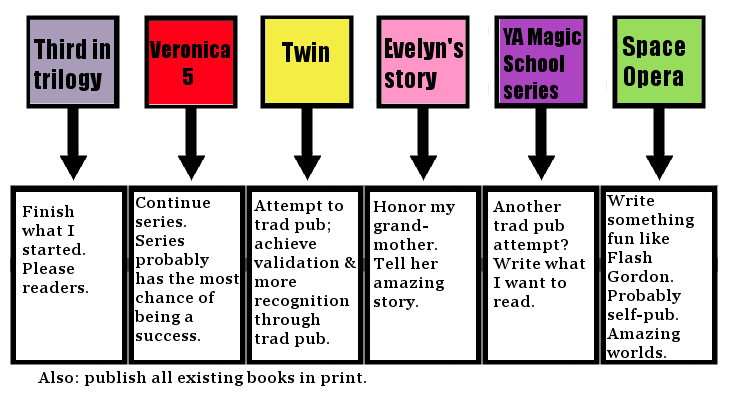
For #2 Wendig talks about how he plans his goals for one year, five years, and ten years. Reading that made me want to make myself a flowchart, so I could visualize my goals. I didn't go beyond a year(ish), though. I mean, my five year goal is basically to have completed the goals in the flowchart, and I can't picture what comes after that. General stuff, sure: be selling enough that I can use some of the money to pay for marketing, for one thing. But that's not a goal I can control so it's just sort of floating there. The one year goals are much more doable, so I focused on those. Of course it's probably more accurate to see them as like, three year goals. Even without two kids (and a third on the way! Yep, I'm insane--it was a surprise, folks, and I'm happy about it but woo-nelly, am I going to be swamped come mid summer)* there's too much to do to finish within a year. And one goal is to try to get traditionally published so that's going to take more than a year anyway, especially since I haven't finished the first draft of the novel I plan on submitting.

Anyway, here's the chart:

I've had several comments from readers of the decopunk books (The City Darkens and After the Fall) about how I need to get the third book out ASAP. I did start working on it a few months ago, but I didn't have a lot of it planned out and ended up stopping because I didn't know where I wanted to take it. I've been thinking about it lately, though, and I think I will probably get back to work on it soon.

I will definitely be writing another Veronica book (which would be book 5). I have several ideas for book 5 as well as book 6, and the world and characters are so familiar and easy to get into now, it's just a matter of deciding that's what I'm doing next, and I'll crank it out. As such, though, it's not my top priority. I do think the Veronica series is the most likely to seriously take off. The decopunk trilogy is going to be too weird for a lot of people, and it has some flaws I just can't figure out how to fix, though I love the story and the characters. The decopunk trilogy has been such an opportunity to stretch myself as a writer, and for me that's worth it, but I am realistic about it. It's not what I set out to do when I started it, for one thing. I trying to create a story like Kushiel's Dart, only set in a decopunk 1920s type world. Loads of people (myself included) wish they could visit Terre d'Ange, and I wanted to create a setting like that. What came out, though, was a cold dystopia I would avoid visiting pretty much at all costs, though. Too much of my cynicism found its way into those books, and book three is going to be very much in the same vein. I don't know if I'm even capable of creating a world that people want to visit or live in. That's actually the core of my goal with the YA magic school series (which may end up being a New Adult rather than YA series, depending on how much sex I want to include--I haven't decided). Yes, I am absolutely going to aim for something reminiscent of Hogwarts, because I love Hogwarts, and I want to manage to write about a setting I love. I'll deviate quite a bit, too. For one thing, I dream of visiting the Mediterranean again one day, so the setting of my magic school will no doubt be very much a place like Corsica or Greece. Maybe it'll be inspired by Ancient Greece, or at least a fantasy version of Ancient Greece. And I can tell you that it's going to be a bit of a response to The Magicians, which I was terribly disappointed with. I mean, come on, what a cool premise! A college like Hogwarts, with adult students learning magic? A loser kid who has a chance to have everything he ever dreamed of? So cool! And then the loser kid never changes or grows or enjoys the gifts he's given. I wanted to throttle him. Anyway. Trying to talk back to The Magicians--that ought to challenge me to step away from my cynicism. If there's a core flaw in The Magicians it's the book's awful cynicism. But in any case, that one's not going to happen any time soon, I want to finish the trilogy and the book I labeled Twin in the flowchart first.

Twin is the working title of the book I wrote during NaNoWriMo this year (made it to 50K!). It was going well but I needed a break because carving out time to write every day was quite a strain on the family. But I'm definitely finishing it, I have lots of notes and ideas. The big question is, do I start with that or the third decopunk book?

And then there's the story of my grandmother Evelyn's life. I found out the third baby is a boy, so there goes my plan to honor my grandmother by naming a child after her (Evelyn used to be a boy's name, up until the 20th century, but I'm not going to saddle a boy with it). My grandmother was the most amazing woman, and one of the kindest, most generous people I have ever known. She used to tell stories of her life all the time, and she had such a fascinating life. Some of the stories were no doubt embellished, and some of my memories of the stories have probably distorted them. And on top of that if I were to write a novel based on her life I'd have to fill in a lot of blanks. So it really would be a novelization of her life. But I think it would be pretty awesome, nevertheless.

And finally the space opera idea... I love soap operas. I love cheesy space stories like Flash Gordon (and A New Hope--it is a space opera, folks, even if it's franchise has perhaps risen above that since--perhaps). The thing that really draws me to write something like that is the challenge of creating amazing worlds and locations, like Cloud City in Empire Strikes Back. Say what you will about Flash Gordon, it took a powerful imagination to create that setting! So often worlds are clearly based on Earth and Earth's existing cultures, but in FG if that's the case it's really not obvious to me. The worlds in FG aren't even spheres! They are floating island-like places with various climates and topography. How does a person imagine places like that? That would be the challenge. Again, that's not happening right away, but I do see it happening most likely within the next three years. We'll see, of course. Another idea may come along and demand to go first. I'm not one to ignore that kind of thing.

What are your writing goals? Can you see beyond the immediate ones, to five or even ten years down the line? What ideas are percolating for you, story-wise?

*FYI if you are my friend on Facebook (not my author page, I'm talking friends with my personal profile) I haven't made an official announcement about the baby yet. All of my immediate family know, but I do intend to put together some sort of cute picture, so please keep the secret until then!

Thursday, June 25, 2015

Book Cover Design FTW!

I've been working on my own covers for a couple of months now. I recently finished the new cover for The City Darkens, pictured to the left. It took a while, but I'm pretty satisfied with it. I need to update the Kindle file associated to it, though, because when you open the file on Amazon for the preview, it still has the old cover in it. No big deal; the old cover wasn't bad, it just didn't quite capture what I wanted. Plus, since the time when the old cover was designed, I've caved as to the content of the blurb that goes with the book. For a long time I wanted to hide the fact that Myadar becomes Raud Grima--I originally intended that to be a very big surprise. But I struggled over that blurb and consulted a lot of people, and they eventually convinced me that I should include that as part of the description. I may revisit it.  

TCD has not been selling much. I haven't tried free promotions for it on Amazon yet. I enrolled it and all the Veronica books save Veronica in Paris in Kindle Select, but I decided to try countdown promotions with TCD and free promos with the Veronica books, to compare results. Well, clearly you shouldn't bother with countdown deals until your books are already selling regularly, because nada with TCD. The free promotions have been very successful with the Veronica books, though. My only complaint there is that I wish that of the 800 or so people who've "bought" the free Veronica books, more than one would post a review (and do it on Amazon, not just Goodreads). I'm not unrealistic. I'd be happy with a 1% return. Eight new reviews. But I'm still waiting.

Anyway, all this to say that I have to wait for the first 90 day period to end in mid July, and then I plan to offer TCD for free five times over the next 90 days, and I hope that'll get it noticed. I also need to go back to editing The City Smoulders and actually publish it.

I'm nervous about designing a cover for TCS, honestly, because while it's the same city, it's very changed. I'm not sure how to go about designing it--ruined by bombs, etc. But the only way to figure it out is to start working on it, so maybe that needs to be my next design project.

Going back to the issue of cover design, I also stumbled across SelfPubBookCovers.com, which sells covers to authors and is fairly easy to submit designs to as an artist. You can see the two I've gotten approved here. I don't know if they'll still be there once they're sold, though. I guess we'll find out.

SelfPubBookCovers rejected this design:


Because of the way the woman sort of blends in to the skyline. I'm going to tweak it a bit and put it on a page here with any other covers I decide not to submit to SPBC, or that they reject but I still think are good. If someone reading is interested in buying one, let me know. I am also more than happy to do a custom design, so if you know someone looking for a cover artist, point them this way.

Saturday, May 23, 2015

New Covers! I'm learning to use GIMP.

Well, after years of being only partly satisfied with most of my book covers, I finally got tired of talking about learning to use a design program like GIMP, and actually started watching youtube videos and teaching myself. In case you don't know, GIMP is a a free downloadable program a bit like Photoshop. The main cover I fret over is for The City Darkens, as I have yet to be really satisfied with any of the covers I've had. But I also had issues with my Veronica Barry covers. This mainly had to do with the titling, which has always been hard to read. Using Paint to make these covers was just short of adequate, in that I got the general look I wanted, but there just wasn't much I could do to really make the fonts stand out the way I wanted them to. So now that I am using GIMP, I've redone them all, and I'm still working on The City Darkens. Here's the original version of The River and the Roses:


And here's the new version:


Here's the old one for The Fire and the Veil:


And the new:


The Plane and the Parade:


And the new:


Veronica in Paris:


And the new:


And here's what I've got so far for The City Darkens:

There's still a lot to be done for it--I don't want the dress to actually look white, for one thing (I was going for light gray, and I'll probably add blue to it) and then I have ideas for other elements in a kind of montage.

The main thing with the Veronica covers, other than making the titles more legible, was to standardize them so they really look like a professionally done series. In honor of my new covers for these, all three novels in the series (Veronica in Paris is a novella and a prequel, and I don't have it enrolled in Kindle Select) will be available for free tomorrow. I'm not planning to offer all three like this again until I launch The Gamble and the Grave (book 4).

What do you think of the covers? Have you worked with GIMP? Have you got any cool tips to share?

Thursday, December 4, 2014

A Nice Boost

So I discovered today that without really trying, I'm back to selling a few books each month. My sales only ever got truly exciting about a year and a half ago when for some reason one April I sold a bunch of books. I was like, "This is it!!! I'm going to be able to quit my day job!" Uh, no. In fact, about two months later my sales tanked lower than they had ever been before. There ensued some desperate marketing of various stripes, until I finally decided I just didn't want to contribute to the spam out there anymore. I pretty much abandoned all marketing, unless you count occasional tweets about dieselpunk stuff. Which honestly, I don't. I do retweet when someone lets me know they are reading one of my books. That's really the only time I mention my books online anymore. I've quit checking my sales, especially these last few months because I'm not writing and seeing zeroes in my sales columns isn't going to help motivate me. But recently a couple of people on Twitter and Goodreads have let me know they are reading or have finished one of my books (mainly The City Darkens) and one of them gave me a five star review, so I thought, okay, let's check the KDP report. And lo and behold, I'm back to the numbers I was seeing regularly before that illustrious April. Nothing to suggest I'll be quitting my day job any time soon, but it really is so nice to know people are reading the books. I find I only ever want to write for an audience, so feeling like there was no audience was just an inspiration killer.

Why a picture of fruit? Why not?
I'm rounding the last base of this pregnancy and writing just isn't going to happen for a while, though. I do spend some time thinking about it. I started a story for NaNoWriMo but only got about 3000 words in. I may end up abandoning it--I don't know. I get ideas for it, but I also get ideas for this middle grade/young adult fantasy novel I was toying with. Though most of the latter have to do more with setting than plot. So I just can't be sure which way I'll go when I am ready to write in earnest. I also have the first draft of the sequel to The City Darkens to revise, and I'm about 3/4 done writing the first draft of book four of my Veronica Barry mystery series. And since actually a number of the books purchased recently were from that series, I do feel like maybe the first thing I need to do is finish that. When I have the time and the energy. Which probably isn't going to be soon.

Friday, May 9, 2014

Just updating for the sake of updating...

The good news is, I'm writing again, without feeling like I have to force myself. It's the first time I've felt that way since last summer, so I'm really pleased about it.

What's not so great is that this comes at a time when I'm feeling exhausted and have a lot on my plate, so I actually haven't had much time to do the writing. Still, I've managed to add about 3,000 words to The Cradle and the Grave (the fourth novel in my Veronica Barry series). It may not sound like much, but I'm glad it's happening.

Now all I have to do is get the rest of the nonsense sorted and I'll be able to finish this novel and add to the series.

In other news, I tried submitting The City Darkens to two agents. One represents Jacqueline Carey and one represented Marion Zimmer Bradley. Several of their novels are inspirations for TCD. Both agencies turned me down, though. The folks who represented MZB were nice about it--I got a personal email, and they said the setting sounded interesting. They didn't tell me why they were turning it down, though my suspicion is that it's because I've already self-published it. I may try again in a bit. I'm thinking of tracking down Cynthia Voigt's agency next. Maybe Sarah Monette's. I don't feel particularly in a rush. I'm mainly doing this because I need to feel like I'm putting my writing out there. I've been sending TCD to book bloggers but since those that have agreed to review it have all let me know it will be a few months, it just feels like I need something else as well. It would be cool to be accepted by an agent. Like a stamp of approval. I think what I've experienced with self-publishing is that while I like everything that comes with self-publishing, like having control over every aspect (especially the cover), I feel like I'm a speck of sand in a beach full of other self-published authors, and most of them have published their first novel without the benefit of a beta-reader or editor. Which means that most readers will assume I'm publishing my first novel without the benefit of a beta-reader or editor, and that is a damn shame, considering the outstanding quality of my beta-reader, Kathryn. Anyway. My hope is that if I do end up getting traditionally published, maybe I will at least not be a speck of sand in a polluted beach anymore. I don't know what I'll be, but at least not that. That's so far down the road, though. Like I said, I'm in no rush, and I think I may have to wait until I write something new--not a Veronica book or a City book--before I'll really have a shot at interesting someone. Time will tell.

Tuesday, March 18, 2014

Draft 1 Done!!! Yay!!!

After several months of dragging and not writing and all that jazz, I have finished the first draft of the sequel to The City Darkens. I have some revisions to do already, and I haven't yet heard back from my beta reader, of course. But a first draft is a first draft, so, Huzzah!

The title looks like it's going to be The City Smolders. One thing I did which was a bit of a gamble is the narrator is a new character, not Myadar. I really like Ginna, though, and it's been a bit of a wild ride with her, as I mentioned in a previous post, as she's the kind of character to take the reigns and go her own way.

Another fun and challenging aspect has been the dialect I've given Ginna. I've taken bits and pieces of English dialects so it resembles many but represents none. My main task has been to be consistent, which hasn't always been easy. One of the goals of the revision process is going to be to make sure the dialect is consistent.

I'll be interest to see the response of my beta reader (and I may see if another person who beta'ed The City Darkens wants to take a crack at this one too) to the book in general and the ending in particular. I won't say more about it than that for now. :)

Monday, February 17, 2014

The New Description for THE CITY DARKENS

Well, as I mentioned, I have spent a chunk of time reworking the description of The City Darkens. I got a lot of help from my good friend Kathryn, as well as the awesome folks over at AbsoluteWrite. After pulling out most of my hair as I struggled to string coherent sentences together, here is the new description:

In an island metropolis, where robots serve the wealthy and glittering skyscrapers light up the night, a woman from a country estate, unschooled in the ways of the court, fights to get back her son and resist the tyrannical new order.

After Myadar Solboi's efforts to navigate the perils of the court lead to betrayal, she becomes an urban incarnation of a legendary highwayman, pursuing revenge on those who wronged her as well as on the capital itself. The city's underclass stirs in response, but before she can rouse them to revolution, she falls into a peril she cannot escape.

This twisting tale of the struggle against the birth of a new, violent age is dystopian decopunk inspired by a 1920s aesthetic. A world of fanatical rulers, ambitious priests, seductive courtiers, shining robots, and a nearly forgotten people living under the city in the sewers... all seen through the shocked eyes of a determined heroine.


That last paragraph may seem like it's all tell and no show; I decided to include it to state my novel's genre in the clearest terms I could come up with, after running into several people who had never heard of dieselpunk, much less dystopian decopunk. Which is a genre I have just coined. I expect all future writers of dystopian decopunk to pay me royalties for coining it, by the way.

What with the new description giving away that Myadar goes all Robin Hood (sort of) I think my cover doesn't quite fit as well. I'd asked the artist, Dolly G, to have Myadar holding this red piece of cloth, so that when people read about Myadar's red silk mask, they'd go, "Oh! That's what she's holding on the cover!" Dolly did a wonderful job, and she really listened to me, so I am grateful to have worked with her. It's just that since the whole mask piece of the story isn't a surprise anymore (can you tell I'm conflicted about this?) it seems like the cover ought to highlight the action aspect more. Hence, I covet a cover (that's fun to say out loud) by Benjamin Carré. Here's one of his works, from his website:

This is the cover to Tim Aker's The Horns of Ruin. I haven't read it, though it's on my ever increasing to-read pile.

I've written Carré twice and he hasn't got back to me. There's an immense chance I couldn't even dream of affording him, but I just wish I could know for sure. Sigh.

Thursday, February 6, 2014

Blurb Writing Hell

Yep, that's where I am. I got some feedback on the blurb I wrote for The City Darkens (along the lines of it sucking) so now I'm trying without a ton of success to rewrite it. I'm really lucky, though, because a bunch of people are helping me (for free!) on AbsoluteWrite. I am genuinely grateful for this. I've realized, though, just how very, very bad I am at writing blurbs. (I've also realized how truly obscure dieselpunk is to the vast majority of people out there, even other writers on AW, but that's not the point of this blog post.)

I never really thought I was great at writing blurbs, you know, but now I have a sense for how truly terrible I am at it. For one thing, I usually only read the first two sentences of a blurb on a novel I'm thinking of reading. I do this not because I'm impatient (well... maybe that too) but because I hate when blurbs have spoilers in them. And they almost always do. And basically a lot of the advice I've been getting from the folks at AW is leading me to do some of that with my TCD blurb. This so goes against my tastes. But let's face it, writing, "This is a really great novel. Trust me. You'll like it. You don't want me to give anything away why, right? Just trust me." Isn't going to work. So I'm biting the bullet and writing a new blurb that says a lot more about the story than the original blurb did.

In my latest attempt, I went and looked at the blurb for Kushiel's Dart, since it was one of the books that I thought of when I was coming up with my ideas for TCD (Cynthia Voigt's Jackaroo was another, as were a couple of Marion Zimmer Bradley novels). I followed the Kushiel blurb line by line, trying to come up with what the equivalent would be for TCD. That was interesting, and some of the AW peeps say they like this latest version the best. Now, of course, I'm going to rework it, both to incorporate the newest feedback but also to change it enough that it's not so close to the Kushiel blurb.

This process is frustrating and tiring and may be interfering with my regular writing energies. In any case, I haven't worked on the WiP in a couple of days. I haven't wanted to, which is disappointing because for a while there I was chugging right along. Today, though, I did think of something that was missing in the story, so with luck, I'll find the energy for it again tomorrow. 

When you read blurbs, do you like there to be a lot of information about the story, or do you avoid finding out a lot, like I do?

What qualities do the best blurbs have?

Friday, January 24, 2014

The Outcome of My Recent Resolution

Anyone with even a slight penchant for cynicism probably would have predicted the outcome of my little "I'm going to wake up early to write" idea without even trying. Yes, you cynics, you were right, that never happened. Not once.

HOWEVER, it is my pleasure to stick my tongue out at you cynical bastards and say I STARTED TO WRITE ANYWAY. (Do you like how I've suddenly turned this into some sort of bizarre adversarial thing between me and unnamed "cynical bastards"? I can be dramatic like that for no good reason other than it amuses me.)

The point is, all of a sudden* I found the energy for it. Isn't that great? Last Saturday, during the little one's nap, I sat down on the couch with my laptop instead of at my desk on my gaming computer where I go to play The Sims. I reread the 48K or so words I had done on the sequel to The City Darkens and then began adding to them. I've written about 10K more so far.

Onwards and upwards. What obstacle have you overcome recently? Even the little ones count.

_________
* It didn't happen out of nowhere. It's all due to my friend and beta-reader Kathryn, who finished reading what I had written and told me the main character, Ginna, is a badass. And I was like, "Yeah, Ginna is a badass. I really like Ginna." And all of a sudden I wanted to be writing Ginna again.

Friday, November 22, 2013

When You Don't Feel Like Writing

First of all, let me say that I do not subscribe to the school of thought that would address this problem with a simplistic, "You write anyway!" exclamation. Writing is not boot camp. Toughing it out may work sometimes, in certain situations. For instance, about a week ago because I'm doing NaNoWriMo I did force myself to write on a day when I felt really stuck, and I did break through the wall I was banging my head against, and so it really was worth it to endure the discomfort of that. But I'm not really talking about that sort of situation here.

What I'm talking about is an overall feeling of blah, I'd rather be <insert other hobby here> that I have sometimes. Generally, I find my writing happens in cycles, and may be tied to seasons. For the last few years, I've had writing frenzies, in which I must write or feel like I'm losing my marbles, mostly in March through May. And I've also always really wanted to do NaNo, ever since discovering it in 2006. I haven't been able to do it every year since then, but in the years that I didn't, I really missed it.

This is the first year that I can do it, I am doing it, and I'm really not into doing it.

I'm not sure why. The story is working. I'm pleased to be back in Veronica's world--in other words, she's not the problem. I can only chalk it up to how hard the summer was. I think I went through a minor depression, and I think I'm not really out of it completely. I've gone through a major depression in the past and this is not like that, but one thing the two do have in common is I have no desire to write.

Now, I have been under the impression in the past that not writing leads me to feel bad, and sends me in the direction of depression. So you'd think doing NaNo would help me get out of this minor depression, but it doesn't seem to be doing that.

Another possibility is that my writing has been taking a darker turn lately. The sequel to The City Darkens (as yet untitled, but technically Luka's Chosen, book 2), is kind of a study in how to write about violence without making it titillating. The fourth Veronica novel, which will probably be called The Cradle and the Grave, although I've been considering reversing the order, has a lot of really dark moments. Which I don't think is entirely out of the ordinary for the series, but I just got through writing some of the darkest scenes, and that's been draining.

Still another option has to do with how my writing happens in general. I go through periods when I don't want to write. Like usually in the summer, despite having more time to do it, I don't write a lot. Summer is for playing outdoors. I actually did try to write quite a bit this summer and eventually gave up as I went into my shell. So it could be that rather than dragging along the vestiges of my minor depression this not wanting to write is really happening because I'm just not in the mood, and I will be in the mood in a couple months. It wouldn't be the first time.
Because, kittens.

So I think when I hit 50K for NaNo I'm stopping for a while. If I do, I'll have two WiPs sitting around at 50K words. Which is uncomfortable. I can't help worrying about them. It's unlikely I'll abandon them so far in, but it does mean I'll have to reread them and scratch my head a bit when I pick them back up to continue with the story. So I don't know. Maybe I'll only take a few days off and then get back into one or the other.

How about you? Do you ever take breaks from writing or producing whatever art or craft you're passionate about? Do you think it's best to always force yourself to keep going?

Wednesday, October 23, 2013

Hello People Who Haven't Quite Given Up on this Blog

Yes, I've been totally MIA blog-wise since June. What can I say, it was a rough summer with little or no writing and fall wasn't much better. There were family issues, there was a move... nothing all that interesting though it effectively brought my blogging and fiction writing to a grinding halt nevertheless. I'm going to reformat The City Darkens today for release as a full novel (no more serialization--I've decided that since no one seemed to think that was as fun as I did, I'm done with it), and I have a new cover (queue excited clapping) done by professional artist Dolly Georgieva-Gode. You get to see it here first:


Also, if you read one or more of the installments of The City Darkens, like the first one, Myadar's Snare, for instance, please comment below with your email and I'll send you a complimentary copy of the full novel. I'll be formatting it so you can skip forward to whichever section you choose, so you don't have to reread the first parts if you don't want to. I would, of course, deeply appreciate your giving the book an honest review on Amazon, Barnes & Noble, and Goodreads.

Wondering if you'd like the book and what it's about?

Here's the blurb:
For ten years Myadar has accepted her life as the estranged wife of a nobleman, running his estate and raising their young son. Everything changes when Myadar is summoned to the capital to begin a new life as a courtier in the decadent, scheming royal court. In a land on the cusp of a new age of modernity, Myadar must decide whether to oppose the rising tyranny that threatens to destroy everything she loves, and risk her own life in doing so.

And here are links to the Goodreads pages of the first three installments from back when it was a serial. You can read reviews there.

Myadar's Snare
Myadar's Betrayal
Myadar's Flight

Tuesday, May 28, 2013

We have a winner!

Well, the Hop Against Homophobia and Transphobia is officially closed. The good news is, I ran the names of all the lovely people who commented on the previous post in order to enter the drawing to win all the episodes of The City Darkens (to download the first episode free, go here) and we have a winner! Lisabet Sarai, please stand up and claim your prize!!! Applause!!!

Okay, so in real life I'll be emailing Lisabet. Thank you all for reading and participating in HAHAT this year. Let me know if you do anything wonderful to promote acceptance of LGBT people in the coming months!

Thursday, May 16, 2013

HAHAT: Hop Against Homophobia and Transphobia

Hello all! I'm happy to say that I'm participating in the Hop Against Homophobia and Transphobia this year. I only just came across it about a month ago, so this is my first year both as a blogger and a general participant.

I had a friend named Rufus when I lived in El Cajon many years ago, who was a sweetie. He liked to flirt with me which I enjoyed very much since my first husband, who I was married to at the time, was pretty lame at making me feel pretty, etc. Rufus was married and had a child, but he also had a boyfriend; I'm not sure if his wife was okay with this or even knew about it. In any case, one night around 2am Rufus and his boyfriend were walking down a street in El Cajon (a low income neighborhood in San Diego known for its white supremacists) hand in hand. Witnesses saw several men stop them. They shot and killed them both execution-style.

The perpetrators were never caught.

I'm deeply happy to be away from El Cajon, but I've found that in NorCal there is still a lot of homophobia. Many people I encounter who don't live in California think that it's a great place for LGBT people, but while you do have pockets like SF, West Hollywood, and Hillcrest in San Diego, there's still a lot of progress to be made.

Friday is International Day Against Homophobia and Transphobia (May 17th). Consider doing something to spread the word about LGBT rights. Got ideas? Post them in the comments!

A couple of other questions to consider for commenting:
Have you ever known anyone targeted with violence solely for some aspect of their identity? Tell us what happened.
What's the best way to handle hate crimes? Should they be punished more severely than other crimes or treated the same?

Comment on this post and add an email and a preferred ebook format. I will do a random drawing of names (using an online utility) and the winner will receive free copies of all of the episodes of The City Darkens, which is LGBT fantasy. You can read more about the first episodes here. Some episodes are not yet out. The winner will receive them as soon as I'm done editing and formatting them.

The contest ends late in the day on May 27th.The winner will be announced on here on the blog (on May 28th, barring some unforeseen obstacle) and contacted via email.

Want to comment but don't want to enter the drawing? Post away! I love reader comments.

Monday, April 29, 2013

Myadar's Flight is out!

Myadar's Flight, the third episode in The City Darkens, is now available for purchase from Amazon and Barnes & Noble. Like the other episodes, it is priced at $0.99.

Here's my description (SPOILERS if you haven't yet read Myadar's Snare--which you can download for free here--and Myadar's Betrayal):

Myadar has struck a blow against Reister, but she still hasn't found Bersi or figured out a way to escape Helésey. After the success of her first foray into the city disguised as Raud Gríma, she determines to don the costume of the legendary highway robber again. This time, however, things will not go as planned.

So far April has been great for sales. I've sold over three times as many books as in any prior month (although since that number was never very high, it's still not like I can quit my day job). It's super exciting, though. I love knowing that people are reading my books! I just hope they enjoy them, too.

What do you think of the cover? Do you have a favorite of the covers for the parts of The City Darkens, yet?

Thursday, April 11, 2013

Grimdark and Violence in Fantasy

Recently I was checking my stats on this blog and saw that someone came here after they did a search for "sophia grimdark martin." Which isn't quite as weird as it sounds, since about a month ago, I think, I went on a minor Twitter monologue about grimdark, and so it would seem that someone out there noticed.

What, you ask, is grimdark?

It's term, apparently originating from the description of a tabletop RPG, Warhammer 40K, set in a future which is "grim" and "dark," and in which everything is war.* I read a very interesting article discussing grimdark in fantasy here, but I wanted to go into a bit myself, because of my ambivalence about it.

As I understand it, grimdark has become a term for dark fantasy that takes violence to a really gruesome level. One of the articles I read about it (might be the one above, I'm not sure) talked about how the genre of horror basically died in the 90s, and was reborn as "dark fantasy." So what has become common, apparently, is for fantasy novels to show ever-more graphic depictions of violence, especially sexual assault and torture. This starts, more or less, with George R. R. Martin's series that I've only experienced as the TV show Game of Thrones (love it, am hooked, often can't take the violence). But from what I read, GRRM is a beginner compared to some of the grimdark stuff that's come out since. And it has also, apparently, become the expectation that fantasy authors write this sort of violence in their novels, and each one seeks to top the one before.

I actually don't know about this first hand, I'm just summarizing the articles I read.

I initially started reading about the grimdark trend because I was worried The City Darkens might be grimdark, and I'd just read about it briefly in an article on TVtropes.org which made it sound like it was generally viewed as a bad thing. However, despite the fact that these articles were critical of it, the authors of these articles were reacting to the trend and its popularity. Apparently, a lot of people like grimdark fiction.

As an aside, The City Darkens isn't grimdark. Not by a longshot, from what I can tell. Yes, there's violence in it. Just not nearly that level of violence. To quote the same article I linked above, "Ringil [in Richard Morgan's The Steel Remains] remembers being gang-raped at a boys’ private school, where all the kids take turns gang-raping each other as part of being hazed." This sort of thing is never going to happen in my books. There's a couple of reasons for that, which I'll get into.

1) I don't read novels with this level of violence, and if a novel contains a sexual assault, it had better be essential to the plot. Even Mélusine, which I reviewed here, and gave five stars to on Goodreads, has a sexual assault scene early on that I could have happily done without. When I don't like reading something, the likelihood of my writing it is very, very low. I have a similar thing with harming animals in fiction. I don't like it as a plot device. I think it's manipulative, because as they've pointed out (here and even better, here) on TVtropes, people get way more upset about an animal or child getting hurt or killed than adult humans. I also cannot stand it if the harming of an animal is in any way supposed to be funny or entertaining. Animals are not here to amuse us with their suffering, folks. The world is hard enough on them already without that.

2) I have a really hard time writing violence of any kind, because ever since I became a mom, all my emotional armor has become swiss cheese. I kid you not. I was never a fan of violence, you understand. I totally freaked my students out the first year I taught American history when I had to ask one of them to take over reading a letter by Michele de Cuneo because I burst into tears (it, too, involves sexual assault). But having my son just destroyed any level of desensitization I formerly built up. I cannot watch suffering dispassionately, and when I write it... yeesh. It's like I'm pulling out my own nails. Which doesn't mean I won't do it. As I mentioned, The City Darkens has violence, and I believe it's important to convey the consequences of things like war, so the violence is, in my opinion at least, fairly realistic. The big difference is, I don't slather on the details.

In fact, I can't imagine writing a story without violence. This is where my ambivalence comes in. I've tried, folks. Remember the plot-bunnies I mentioned about an Edwardian romance? I thought writing romance might be a good idea for me, so I could avoid violence. Well, it doesn't work for me. I love reading Edwardian romance, but when it comes to writing, it seems I cannot escape violence. In Broken Ones, there's domestic violence. In my Veronica series, there are murders and arson and plane crashes and other violent situations. And in The City Darkens there's still more violence.

I like to say I write to preserve my sanity, and that is true. I do go through seasons where I don't write, and that's okay, but when I'm in a writing phase, not writing very quickly makes me antsy, irritable... it makes PMS and pregnancy hormones look like a joke, people. While I often enjoy writing most when it's acting as an escape for me, it's also a form of therapy, in reality. There's a part of Myadar's Snare that is incredibly painful for me to write and to reread. Whenever I revise it, I just hate that part. It's because I gave myself this challenge, to write one of my greatest fears. So rereading it means going through that fear again. Ultimately, I hope it makes the story more authentic, but man. So unfun.

It brings to mind two (very different) authors. Nalo Hopkinson used to participate on a feminist sci fi and fantasy listserv I belonged to for a while. We read Brown Girl in the Ring for a book of the month. There's a scene where a character gets flayed alive, and someone on the listserv talked about how awful it was to read. Nalo Hopskinson responded that it also had been incredibly hard to write, which surprised the woman who had posted originally. She said she had never thought about whether a scene had been hard for an author to write. That really stuck with me, because I was already writing back then, but I hadn't really ever written anything that was that hard for me. In fact, I'd say that the first time I truly did that was in Myadar's Snare. It happens again later in The City Darkens, too. But up until then, I did write scenes that were hard scenes, but they were almost always fueled by anger, not tapping into fear or pain so much. Certainly not recent, raw pain or the way I imagine I would feel if something I am currently very afraid of would come to pass. I'd be more likely to draw on old fears or old pain, if that makes sense.

The other author is Stephen King. I'm not sure where I read this; probably Danse Macabre because I'm pretty sure it predated On Writing. He said he didn't really have a choice about what he wrote. He used a metaphor, which I'll paraphrase, but just be aware I'm probably getting it wrong... He said writing is like a strainer in your mind. All this muck passes through it, and some stuff says in it, and that's what you write about. He said that if he had a choice, he'd write like Amy Tan.

So violence is part of the muck in my strainer, I guess. And as such, I can't out-and-out condemn grimdark, because it's just taking that same muck to a much more extreme level, after all. I think, and this was pointed out in some of the articles that I read, that the real problem with grimdark is that it's violence for violence's sake a lot of the time, and that just seems like someone needs a better editor. Violence in novels and any other fiction medium really needs to have a purpose. It's like my issues with animal harm in fiction. That can really be applied more broadly to all violence. Violence can be used in a really cheaply manipulative way, and if that's why it's there, it's no bueno. Violence should exist in stories only when its absence would make a story impossible to tell.

How about you, do you have "muck" in your "strainer" that you have ambivalent feelings about? Have you pushed yourself to write something that is unpleasant for you to reread?
How do you feel about violence in fiction?

_______________________________________
*The hashtag #grimdark apparently has some sort of My Little Pony connection I find... disturbing.